What Lives in the Dead Sea? The Complete Guide to Life in Earth’s Saltiest Lake
Is the Dead Sea Really Dead? The Dead Sea is one of Earth’s most extreme natural environments—so salty, so dense, and so mineral-rich that it has fascinated scientists, explorers, and travelers for centuries. Located between Jordan, Israel, and the West Bank, the Dead Sea is famous for:
- its impossibly high salt concentration
- the ability to float effortlessly
- therapeutic minerals
- dramatic landscape at the lowest point on Earth
But one question sparks endless curiosity:
Does anything live in the Dead Sea?
Despite its ominous name, the Dead Sea is not completely dead. Although no fish, plants, or aquatic animals can survive its hypersaline waters, a hidden microscopic world thrives beneath the surface.
This explores:
- the organisms that live in the Dead Sea
- how they survive extreme salinity
- why other life cannot
- the mystery of the Dead Sea turning red
- the surprising freshwater springs discovered underwater
Let’s dive into the unseen world of life in one of the harshest habitats on Earth.
Where is the Dead Sea Located?
The Dead Sea is a landlocked salt lake bordered by:
- Jordan (east)
- Israel (west)
- The West Bank (northwest)
Key Facts About the Dead Sea
- Elevation: 423 meters (1,388 ft) below sea level — lowest point on Earth
- Salinity: 33.7%, nearly 10x saltier than the ocean
- No outlet (water only leaves through evaporation)
- Shrinking rapidly due to water diversion and climate changes
Its extreme saltiness makes it impossible for typical marine species—like fish, crustaceans, or aquatic plants—to survive. But life always finds a way.
Does Anything Live in the Dead Sea? (YES — Microscopic Life Exists)
The Discovery of Life in the Dead Sea
In the 1930s, microbiologist Benjamin Elazari-Volcani discovered something remarkable:
Tiny organisms were thriving in the Dead Sea despite its harsh conditions.
These include:
- Halophilic (salt-loving) bacteria
- Archaea
- Dunaliella algae
- Protozoans
- Extremophiles that survive where nothing else can
These organisms belong to a special group known as halophiles—microbes that not only survive but require extremely salty environments.
What Lives in the Dead Sea?
Below are the only life forms capable of surviving the Dead Sea’s hypersaline habitat:
1. Halophilic Bacteria
These salt-loving bacteria thrive at salinity levels that would instantly kill most life forms.
Characteristics:
- Survive by regulating internal salt concentrations
- Give the water a faint reddish or purplish tint during blooms
- Essential for the Dead Sea’s microscopic ecosystem
2. Archaea (the Ultimate Survivors)
Archaea are even tougher than bacteria.
They:
- withstand conditions hotter, colder, and saltier than life elsewhere
- dominate the Dead Sea’s microbial population
- play a key role in balancing its chemical environment
Many archaea species turn red or pink, which becomes important in rare Dead Sea color changes.
3. Dunaliella Algae
This microalga is the only eukaryotic organism that consistently lives in the Dead Sea.
It survives by producing:
- glycerol (protects cells from extreme salt damage)
- beta-carotene (gives it an orange or red pigment)
This combination helps Dunaliella thrive where no other algae can.
4. Protozoans
Some protozoa species can temporarily survive when the Dead Sea’s salinity drops after floods.
They do not thrive long-term, but their brief presence contributes to rare biological events.
Why Can’t Fish Live in the Dead Sea? (Scientific Explanation)
Fish, snails, frogs, and aquatic plants cannot survive in the Dead Sea for several reasons:
1. Extreme Salinity (33.7%)
Salt pulls water out of cells, causing cellular dehydration and immediate death.
2. No Freshwater Outflow
The Dead Sea is terminal—meaning water enters but never exits.
Evaporation leaves behind dissolved minerals, making salt concentrations rise continuously.
3. Osmotic Shock
When freshwater fish are accidentally washed in by floods, they typically die within minutes.
4. Lack of Oxygen
The Dead Sea contains extremely low dissolved oxygen levels—another barrier for fish.
Freshwater Springs: The Dead Sea’s Hidden Oases
One of the most exciting scientific discoveries occurred in 2010, when divers found clusters of freshwater springs beneath the Dead Sea.
These underwater springs
- lie inside deep craters (some 90 feet long)
- host dense microbial ecosystems
- support life forms unprecedented in hypersaline environments
Microorganisms Found in These Springs
- cyanobacteria
- salt-tolerant algae
- protective biofilms on rocks
- chemosynthetic microbial communities
Hot springs like Zerka Ma’in and Zara are especially rich in cyanobacteria, turning them into vibrant mini-habitats.
These underwater oases reveal that the Dead Sea is much more biologically complex than once believed.
Did the Dead Sea Turn Red During Floods? (The 1980 Phenomenon)
Yes—the Dead Sea famously turned red in 1980 after heavy rainfall and flooding.
Why did it happen?
- Floods temporarily reduced the Dead Sea’s salinity (from 35% to ~30%)
- Lower salinity allowed Dunaliella algae to bloom
- Dunaliella produces pigments that attract red halobacteria
- Together, they turned the water a deep reddish color
This rare natural event demonstrated the dramatic environmental impact of salinity fluctuations in the region.
Is the Dead Sea Really Dead? (Final Scientific Verdict)
The Dead Sea is dead to fish, plants, and animals — but vibrant with microscopic life.
Thriving Life Forms Include
- Halophilic bacteria
- Archaea
- Dunaliella algae
- Microbial mats around freshwater springs
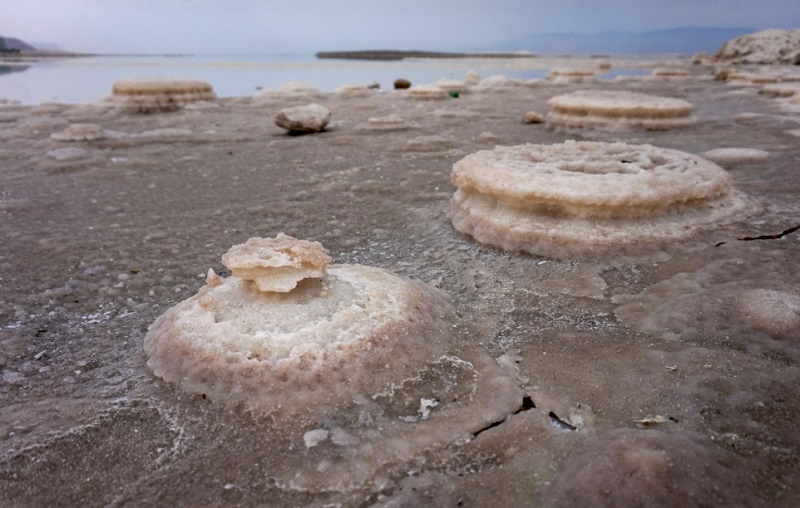
Although invisible to the naked eye, these resilient extremophiles form one of Earth’s most extraordinary biological communities.
Conclusion: The Dead Sea’s Incredible Hidden Ecosystem
While its name suggests lifelessness, the Dead Sea is far from empty. Its waters—rich with salt and minerals—support a fascinating world of extremophiles that have adapted to survive conditions nearly impossible for other forms of life.
From halophilic bacteria to microalgae, to thriving underwater springs and rare red blooms, the Dead Sea teaches us a powerful scientific truth:
Life always finds a way—even in the harshest and most unlikely environments.
This extraordinary lake reminds us that Earth is full of surprises, and even places named “dead” can host vibrant, thriving microscopic worlds beneath the surface.
FAQs
What organisms live in the Dead Sea?
Halophilic bacteria, archaea, Dunaliella algae, and microbial biofilms.
Did fish ever live in the Dead Sea?
No, fish cannot survive the extreme salinity.
Why is the Dead Sea so salty?
It has no outlet, so water evaporates and leaves behind concentrated minerals.
Can the Dead Sea support life?
Yes—though only microorganisms, not plants or animals.
Why did the Dead Sea turn red?
Due to blooms of Dunaliella algae and red halobacteria during floods.
Are there freshwater springs in the Dead Sea?
Yes—recent discoveries show underwater springs that support microbial diversity.