What Is 0.03125 as a Fraction? (Step-by-Step Solution)
Decimals and fractions are simply two different ways of expressing the same value. While decimals are often used for calculations, fractions are useful in mathematics, measurements, engineering, and everyday problem-solving.
If you’re wondering what 0.03125 is as a fraction, the answer is straightforward once you understand the conversion process.
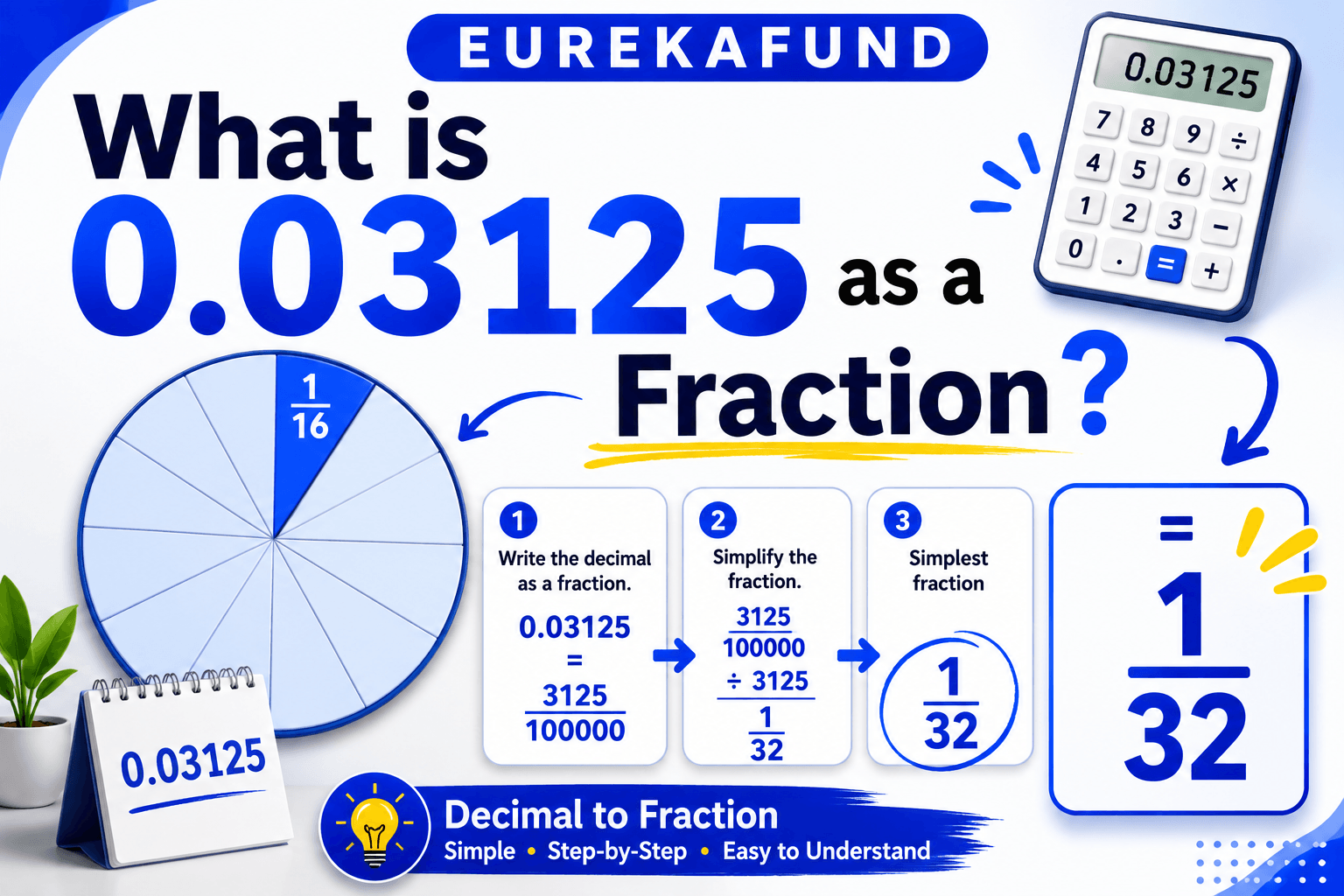
Quick Answer: 0.03125 as a fraction is 1/32.
To convert the decimal into a fraction, write it over its place value and simplify until no common factors remain.
How to Convert 0.03125 to a Fraction
Follow these simple steps.
Step 1: Write the Decimal as a Fraction
Since 0.03125 has five digits after the decimal point, write it over 100,000.
0.03125 = 3125/100000
Step 2: Simplify the Fraction
The numerator and denominator can both be divided by 3,125.
3125 ÷ 3125 = 1
100000 ÷ 3125 = 32
This leaves: 1/32
Final Answer: 0.03125 = 1/32
The fraction 1/32 is already in its simplest form.
Why Does 0.03125 Equal 1/32?
Fractions and decimals represent the same quantity in different formats.
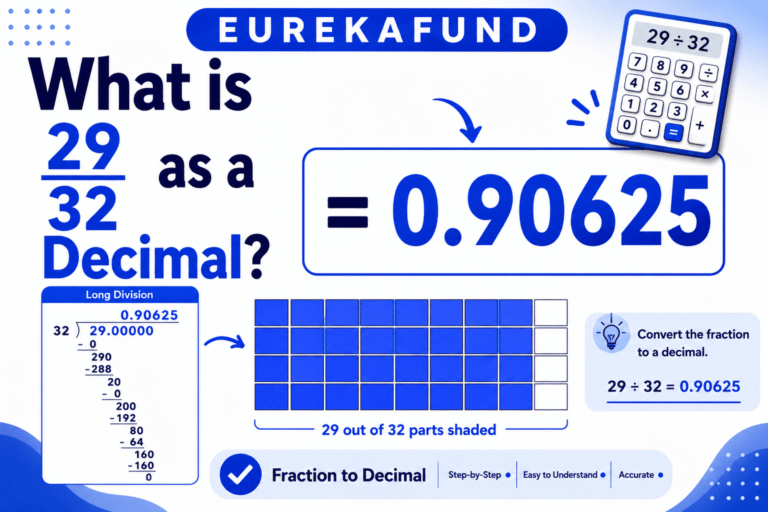
When you divide 1 by 32, the result is exactly:
1 ÷ 32 = 0.03125
This means the decimal 0.03125 and the fraction 1/32 have exactly the same value.
Is 1/32 Already Simplified?
Yes.
A fraction is in its simplest form when the numerator and denominator have no common factors other than 1.
Since the numerator is 1, there are no additional factors that can simplify the fraction.
Therefore: 1/32 is the lowest possible form.
Decimal, Fraction, and Percentage
The same value can be written in three common ways.
| Form | Value |
| Decimal | 0.03125 |
| Fraction | 1/32 |
| Percentage | 3.125% |
To convert the decimal into a percentage, simply multiply by 100.
0.03125 × 100 = 3.125%
Where Is 0.03125 Commonly Used?
Although it may seem like an unusual decimal, 0.03125 appears in several practical situations.
Measurements
The fraction 1/32 is a common unit in:
- Woodworking
- Metal fabrication
- Precision machining
- Construction plans
For example, measuring tapes, rulers, and engineering drawings often use 1/32-inch increments.
Mathematics
Teachers frequently use terminating decimals like 0.03125 when teaching students how to convert between decimals and fractions because they simplify neatly.
Engineering and Manufacturing
Precision manufacturing often relies on fractional measurements. Understanding that 0.03125 equals 1/32 helps when converting between decimal and fractional dimensions.
Common Mistakes When Converting 0.03125
Using the Wrong Place Value
Some people write: 3125/10000
This is incorrect because 0.03125 contains five decimal places, not four.
The correct starting fraction is:
3125/100000
Forgetting to Simplify
Another common mistake is stopping after writing:
3125/100000
Although mathematically correct, this is not the simplest form.
Reducing the fraction gives: 1/32
Frequently Asked Questions
Is 0.03125 a terminating decimal?
Yes. It ends after five decimal places, so it is called a terminating decimal.
Can 0.03125 be written as a mixed number?
No. A mixed number is used for values greater than one. Since 0.03125 is less than one, it is written as the proper fraction 1/32.
What percentage is 0.03125?
Multiply the decimal by 100.
0.03125 × 100 = 3.125%
So, 0.03125 is equal to 3.125%.
Why is the denominator 32?
After writing the decimal as 3125/100000, both numbers are divisible by 3,125.
Dividing each by 3,125 leaves: 1/32
Related Decimal Conversions
If you’re learning decimal-to-fraction conversions, you may also find these helpful:
- What is 0.015625 as a fraction?
- What is 0.0625 as a fraction?
- What is 0.09375 as a fraction?
- What is 0.125 as a fraction?
- What is 3.125% as a fraction?
Conclusion
Converting 0.03125 into a fraction is simple once you identify its place value. Writing it as 3125/100000 and simplifying by dividing both the numerator and denominator by 3,125 gives the final answer:
0.03125 = 1/32 Knowing how to convert decimals into fractions is a useful math skill that can help with measurements, percentages, engineering calculations, and everyday problem-solving.