What is 1/5 as a Decimal? (Step-by-Step Conversion and Examples)
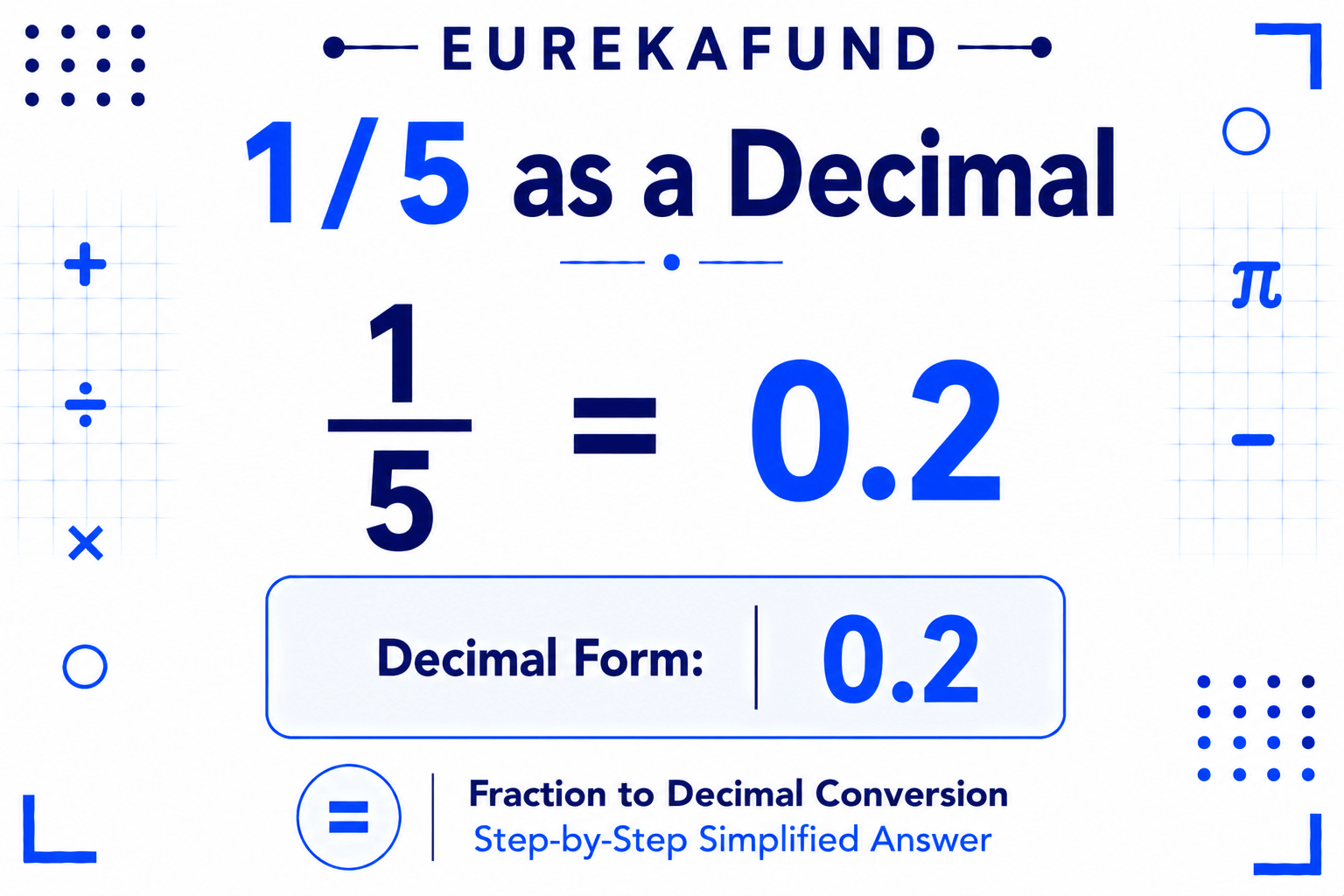
Quick Answer: 1/5 as a decimal is 0.2.
It is a terminating decimal, meaning it ends and does not repeat.
What Is 1/5 as a Decimal?
To convert the fraction 1/5 into decimal form, divide the numerator by the denominator:
1 ÷ 5 = 0.2
The decimal 0.2 is exact and finite, so it can be used directly in calculations without rounding or approximation.
Step-by-Step: How to Convert 1/5 Into a Decimal
Method 1: Direct Division
Divide the numerator by the denominator:
1 ÷ 5 = 0.2
Method 2: Convert the Fraction to Tenths
Multiply both the numerator and denominator by 2:
1 × 2 = 2
5 × 2 = 10
So the fraction becomes:
2/10 = 0.2
This decimal value is equivalent to 0.2 as a fraction
How to Verify That 1/5 = 0.2
Method 1: Multiply Back
0.2 × 5 = 1
This confirms the decimal conversion is correct.
Method 2: Prime Factor Rule
The denominator 5 contains only the prime factor 5, so the decimal must terminate.
Method 3: Calculator Check
Dividing 1 by 5 on any calculator gives 0.2 exactly.
Is 1/5 a Terminating or Repeating Decimal?
1/5 is a terminating decimal.
Why?
A fraction converts to a terminating decimal when its denominator has only 2 and/or 5 as prime factors.
Since the denominator here is 5, the decimal ends naturally.
Understanding the Size of 1/5
The decimal 0.2 means:
- The value is less than 1
- It represents two-tenths of a whole
- It is equal to 20%
Fraction, Decimal, and Percentage Forms
| Form | Value |
| Fraction | 1/5 |
| Decimal | 0.2 |
| Percentage | 20% |
To convert to a percentage:
0.2 × 100 = 20%
Real-Life Examples and Uses of 1/5
In everyday use, people usually say 0.2 or 20%, while 1/5 appears in ratios, rules, or intermediate steps.
1. Task Completion
Completing 1 out of 5 tasks means 20% of the work is done.
2. Discounts and Offers
A discount of 1/5 of the price means the customer saves 20%.
3. Time Management
Spending 1/5 of an hour on an activity equals 0.2 hours, or 12 minutes.
4. Resource Sharing
If 1/5 of resources are allocated to a department, it receives 20% of the total.
5. Probability Basics
If one favorable outcome exists among five equally likely outcomes, the probability is 1/5 = 0.2.
Common Mistakes to Avoid
- ❌ Writing 0.02 instead of 0.2
- ❌ Assuming the decimal repeats
- ❌ Forgetting to convert correctly to percentage
- ❌ Rounding when an exact value exists
Because 0.2 is exact, it should always be used as written.
FAQs About 1/5 as a Decimal
Is 1/5 a terminating decimal?
Yes. 1/5 equals 0.2, which is a terminating decimal.
Can 1/5 be written exactly as a decimal?
Yes. The decimal 0.2 is exact.
Why does 1/5 not repeat?
Because the denominator contains only the prime factor 5.
What is 1/5 as a percentage?
It equals 20%.
Final Answer Summary
- 1/5 as a decimal = 0.2
- It is a terminating decimal
- The value is exact and non-repeating
- Commonly used in percentages, ratios, and everyday calculations