

How Big Is a Chunk in Minecraft?
Quick Answer: A chunk in Minecraft is 16 blocks wide, 16 blocks long, and 384 blocks tall, containing 98,304 blocks in total.
Chunks are the core units Minecraft uses to generate, load, and manage the game world.
What Is a Chunk in Minecraft?
A chunk in Minecraft is a fixed-size section of the world used by the game engine to generate terrain, load structures, and manage performance.
Instead of loading the entire world at once, Minecraft divides the world into chunks. This system allows the game to:
- Load only nearby areas
- Reduce memory usage
- Improve performance and stability
For new players, chunks may feel invisible, but they control world generation, mob spawning, redstone behavior, and farms.
Why Minecraft Uses Chunks
Minecraft worlds are extremely large—effectively infinite. Chunks allow the game engine to:
- Generate terrain only when needed
- Save and unload distant areas
- Keep gameplay smooth even on large maps
Without chunks, Minecraft would struggle to manage terrain, entities, and player actions efficiently.
How Big Is a Chunk in Minecraft? (Exact Size)
Chunk Dimensions
One chunk in Minecraft measures:
- 16 blocks wide (X-axis)
- 16 blocks long (Z-axis)
- 384 blocks tall (Y-axis)
This height applies to modern versions of Minecraft (1.18 and later), where the world extends from Y = -64 to Y = 319.
Total Blocks Per Chunk
16 × 16 × 384 = 98,304 blocks per chunk
This count includes all block types such as stone, dirt, air, ores, and fluids.
📌 Older Minecraft versions had a chunk height of 256 blocks. This was expanded in the Caves & Cliffs update.
How Chunks Are Generated in Minecraft
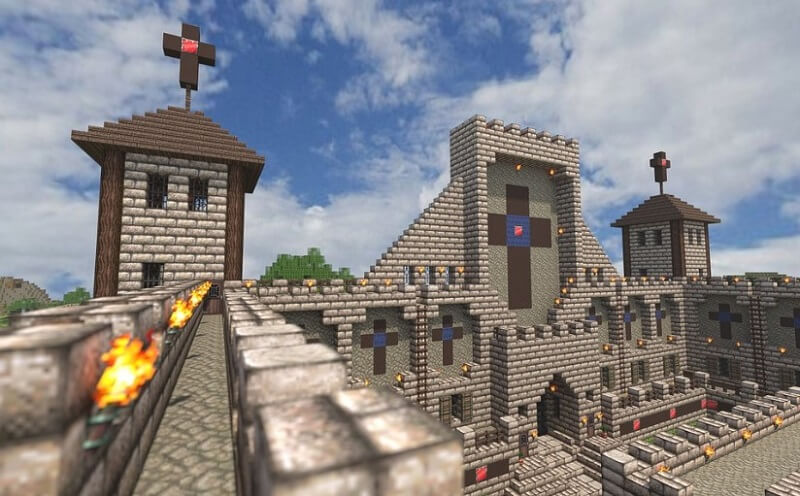
Chunks are generated dynamically as the player explores the world.
When you enter a Minecraft world:
- The game generates chunks around your spawn point
- Additional chunks generate as you move
- Terrain generation depends on the world seed
If you use the same seed, same game version, and same world generator, the chunk layout will be identical every time.
Chunk Loading Explained
Chunk loading determines which chunks are active and functional at any moment.
Loaded chunks:
- Process redstone
- Allow crops to grow
- Spawn mobs
- Update entities
Unloaded chunks:
- Remain frozen
- Do not process game logic
- Are stored on disk to save resources
What Are Chunk Tickets?
Chunk tickets are internal mechanics that force chunks to stay loaded.
Minecraft uses tickets to decide which chunks remain active. Each ticket has:
- Ticket type – why the chunk is loaded (player, portal, redstone, etc.)
- Ticket level – how far loading extends
- Time to live (optional) – how long the chunk stays loaded
These mechanics are critical for:
- Automated farms
- Redstone machines
- Nether portal chunk loaders
Spawn Chunks Explained
Spawn chunks are chunks that remain loaded even when players are far away.
In Java Edition:
- The area around the world spawn stays loaded
- Typically spans a 19×19 chunk region
- Ideal for farms that need constant operation
Spawn chunks are unaffected by render distance and stay active unless disabled.
How to Identify Which Chunk You Are In
You can see chunk boundaries using the debug screen.
Steps:
- Press F3 + G (Java Edition)
- Yellow grid lines appear
- Each grid square represents one chunk
This feature is extremely useful for:
- Aligning farms
- Chunk-based builds
- Optimizing redstone contraptions
Why Chunk Size Matters for Gameplay
Chunk size directly affects:
- Mob spawning mechanics
- Farm efficiency
- Redstone timing
- World performance
For example:
- Mob farms are designed based on chunk borders
- Redstone machines may break if split across chunks
- Large builds are optimized by aligning with chunk edges
Understanding chunk boundaries gives players a technical advantage.
Chunks vs Regions (Important Distinction)
Chunks are not the same as region files.
- Chunks: 16×16 block sections used in gameplay
- Regions: Groups of 32×32 chunks used for world storage
This distinction matters for:
- World backups
- Server optimization
- Map editing tools
Common Misconceptions About Minecraft Chunks
Many players misunderstand chunks. Here are common mistakes:
- Thinking chunks are visible blocks
- Assuming chunks load permanently
- Believing chunk size changes with settings
- Confusing render distance with chunk size
Chunk size is fixed. Only how many chunks load changes.
People Also Ask (PAA)
How many blocks are in a Minecraft chunk?
A Minecraft chunk contains 98,304 blocks in modern versions.
Are chunks always 16×16?
Yes. The width and length are always 16×16 blocks.
Did chunk height change in Minecraft?
Yes. Chunk height increased from 256 to 384 blocks in version 1.18.
Do chunks affect mob spawning?
Yes. Mob spawning mechanics are calculated per chunk.
Can chunks stay loaded without players?
Yes. Spawn chunks and chunk loaders can keep chunks active.
Final Takeaway
Chunks are the foundation of how Minecraft works. Each chunk is a 16×16×384 block section that controls world generation, performance, and gameplay mechanics. Whether you are building farms, designing redstone systems, or optimizing a server, understanding chunks gives you a major advantage.
Once you master chunk mechanics, Minecraft stops feeling random—and starts feeling controllable.