5/8 as a Decimal (Clear Step-by-Step Explanation)
Converting fractions into decimals is a fundamental math skill used in everyday life, education, measurements, and technical fields. One common fraction people often need to convert is 5/8.
So the question is simple:
What is 5/8 as a decimal?
In this guide, you’ll learn how to convert 5/8 into a decimal step by step, understand whether it is a terminating or repeating decimal, see how place value explains the result, and explore real-life situations where this conversion is commonly used.
What Is a Fraction?
A fraction represents a part of a whole and consists of two numbers:
- Numerator – the top number, showing how many parts you have
- Denominator – the bottom number, showing how many equal parts make up the whole
In the fraction 5/8:
- Numerator = 5
- Denominator = 8
To convert any fraction into a decimal, you divide the numerator by the denominator.
So for 5/8, we calculate:
5 ÷ 8
Converting 5/8 into a Decimal
Step 1: Divide the Numerator by the Denominator
Because 5 is smaller than 8, the result will be less than 1. We add a decimal point and continue the division.
Step 2: Perform Long Division
Follow the division process:
- 8 goes into 50 6 times (8 × 6 = 48)
- Remainder: 50 − 48 = 2
- Bring down a 0 → 20
- 8 goes into 20 2 times (8 × 2 = 16)
- Remainder: 20 − 16 = 4
- Bring down another 0 → 40
- 8 goes into 40 5 times (8 × 5 = 40)
- Remainder: 0
The division ends here.
✅ Final Decimal Result
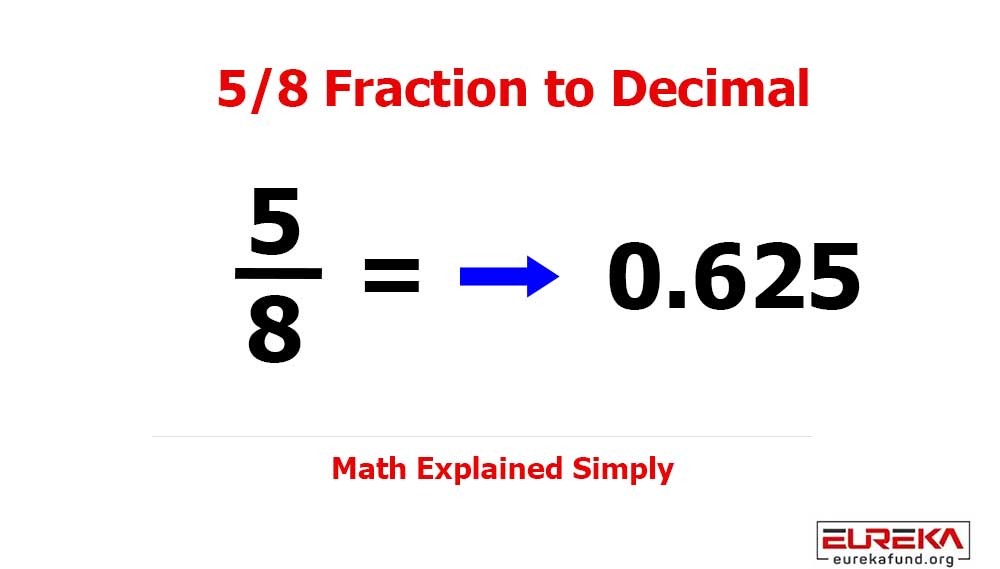
5 ÷ 8 = 0.625
So,
5/8 as a decimal = 0.625
Looking for the fractional form instead? See 0.625 as fraction for a clear step-by-step explanation.
Is 5/8 a Repeating Decimal?
No, 5/8 is not a repeating decimal.
The decimal 0.625 ends after three decimal places, which makes it a terminating decimal.
This happens because the denominator 8 = 2 × 2 × 2, and fractions whose denominators contain only factors of 2 and/or 5 always convert into terminating decimals.
Understanding 0.625 Using Place Value
The decimal 0.625 can be explained using place values:
- 0.6 = 6 tenths = 6/10
- 0.02 = 2 hundredths = 2/100
- 0.005 = 5 thousandths = 5/1000
So:
0.625 = 6/10 + 2/100 + 5/1000
This breakdown shows how each digit contributes to the total value and connects the decimal back to fractional parts.
Real-Life Uses of 5/8 as a Decimal
📏 Measurements
- 5/8 inch = 0.625 inches
- Common in construction, carpentry, and home improvement
🍳 Cooking & Baking
- Recipes may require precise measurements
- Digital scales and tools often display values like 0.625
💰 Money & Finance
- 0.625 dollars = 62.5 cents
- Used in pricing, discounts, and financial calculations
🧪 Science & Engineering
- Decimals like 0.625 are used for accuracy in formulas
- Helpful when converting fractional measurements into decimal form
Comparing Common Fractions and Decimals
| Fraction | Decimal |
| 1/2 | 0.5 |
| 1/4 | 0.25 |
| 3/8 | 0.375 |
| 5/8 | 0.625 |
| 3/4 | 0.75 |
Rounding and Approximation
In some situations, decimals are rounded for simplicity:
- 0.625 rounded to two decimal places → 0.63
- Rounded to one decimal place → 0.6
Rounding is useful when exact precision is not required, such as estimates or quick calculations.
Common Mistakes to Avoid
- ❌ Writing 5/8 as 0.62 without rounding explanation
- ❌ Confusing 5/8 with 3/4
- ❌ Assuming all fractions create repeating decimals
- ❌ Forgetting that 5/8 equals more than 1/2
Always divide carefully and check whether the decimal terminates.
FAQs: 5/8 as a Decimal
What is 5/8 as a decimal?
5/8 as a decimal is 0.625.
Is 5/8 a terminating decimal?
Yes. The decimal ends after three places.
Why does 5/8 not repeat?
Because the denominator contains only the factor 2.
What is 5/8 as a percentage?
0.625 × 100 = 62.5%
Is 5/8 greater than 1/2?
Yes. 5/8 (0.625) is greater than 1/2 (0.5).
Final Answer
5/8 as a decimal = 0.625
Key Takeaway
To convert 5/8 into a decimal:
- Divide 5 by 8
- Perform long division
- Get 0.625
- Confirm it is a terminating decimal
Understanding fraction-to-decimal conversions like this is essential for math, measurements, finance, cooking, and technical work, making everyday calculations clearer and more accurate.