4.875 as a Fraction (Clear Step-by-Step Conversion)
Decimals like 4.875 often appear in manufacturing specs, pricing models, digital design grids, and technical measurements. While decimals work well for calculators, fractions are often preferred when clarity and exactness matter.
So let’s answer the main question:
What is 4.875 as a fraction?
This guide explains the conversion process, simplifies the result, verifies accuracy, and shows how this value is used in real-world contexts.
Why Convert 4.875 into a Fraction?
Converting decimals into fractions is useful when:
- Precision matters
- Instructions must be clearly communicated
- Working with fixed measurement systems
- Avoiding rounding or approximation errors
- Teaching or learning fraction concepts
For example, 4 7/8 units is much easier to visualize than 4.875 units in planning or documentation.
Step 1: Write 4.875 as a Fraction
The decimal 4.875 has three digits after the decimal point, meaning it represents thousandths.
Write it as:
4.875 = 4875 / 1000
This fraction is correct, but it is not yet simplified.
Step 2: Simplify the Fraction
To reduce a fraction, divide both the numerator and denominator by their Greatest Common Divisor (GCD).
Find the GCD
Both 4875 and 1000 are divisible by 125.
Divide both numbers by 125
- 4875 ÷ 125 = 39
- 1000 ÷ 125 = 8
✅ Final Simplified Fraction
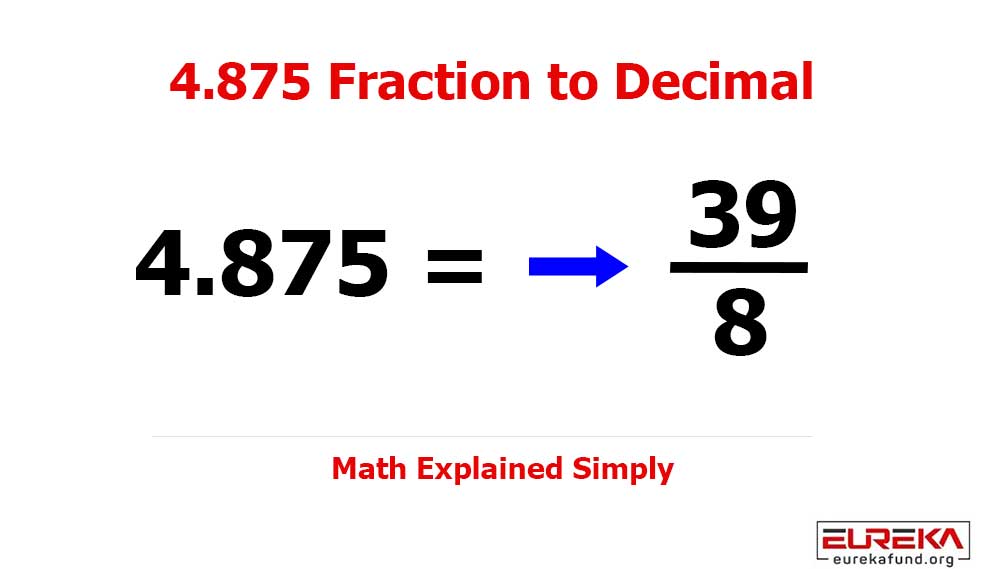
4.875 as a fraction (simplest form): 39/8
To see how this value appears as a decimal, visit: What is 39/8 as a Decimal? (Step-by-Step Conversion and Rounding Guide)
Optional: Convert to a Mixed Number
Since 39/8 is an improper fraction, it can be written as a mixed number.
- 39 ÷ 8 = 4 remainder 7
So:
39/8 = 4 7/8
Both forms represent the same value.
Step 3: Verify the Result
Decimal Verification
Divide the numerator by the denominator:
39 ÷ 8 = 4.875
✔ Verified
Cross-Multiplication Check
- 4875 × 8 = 39,000
- 39 × 1000 = 39,000
✔ Both sides match, confirming the conversion is correct.
Real-World Examples of 4.875 as a Fraction
🖥 Digital Layout & Design
- A grid width of 4.875 units equals 4 7/8 units
- Useful in precise layout alignment and spacing
📦 Packaging & Manufacturing
- A component length of 4.875 cm is specified as 4 7/8 cm
- Fractions reduce ambiguity in production notes
📊 Data Thresholds
- A tolerance value of 4.875 is easier to interpret as 39/8 in calculations
- Common in technical documentation
📐 Blueprint Scaling
- Scale markings often prefer fractions over long decimals
- 4 7/8 is easier to read at a glance than 4.875
Common Mistakes to Avoid
- ❌ Writing 4875 / 100 instead of 4875 / 1000
- ❌ Forgetting to simplify the fraction
- ❌ Confusing 4.875 with 4.75 or 4.5
- ❌ Leaving the answer only as 39/8 without noting the mixed form
Always confirm decimal places before converting.
FAQs: 4.875 as a Fraction
What is 4.875 as a fraction in simplest form?
4.875 = 39/8
Can 4.875 be written as a mixed number?
Yes. 4.875 = 4 7/8
Is 4.875 a terminating decimal?
Yes. It ends after three decimal places.
Is 4.875 a rational number?
Yes. All terminating decimals are rational numbers.
Why does 4.875 simplify so neatly?
Because both numbers share a common factor, allowing clean reduction.
✅ Final Answer
4.875 as a fraction = 39/8 = 4 7/8
Key Takeaway
To convert 4.875 into a fraction:
- Write it as 4875 / 1000
- Divide by the GCD (125)
- Simplify to 39/8
- Convert to 4 7/8 if needed
This method works for all terminating decimals and is especially helpful in technical, educational, and precision-based fields.
You may also find these related fraction examples helpful: