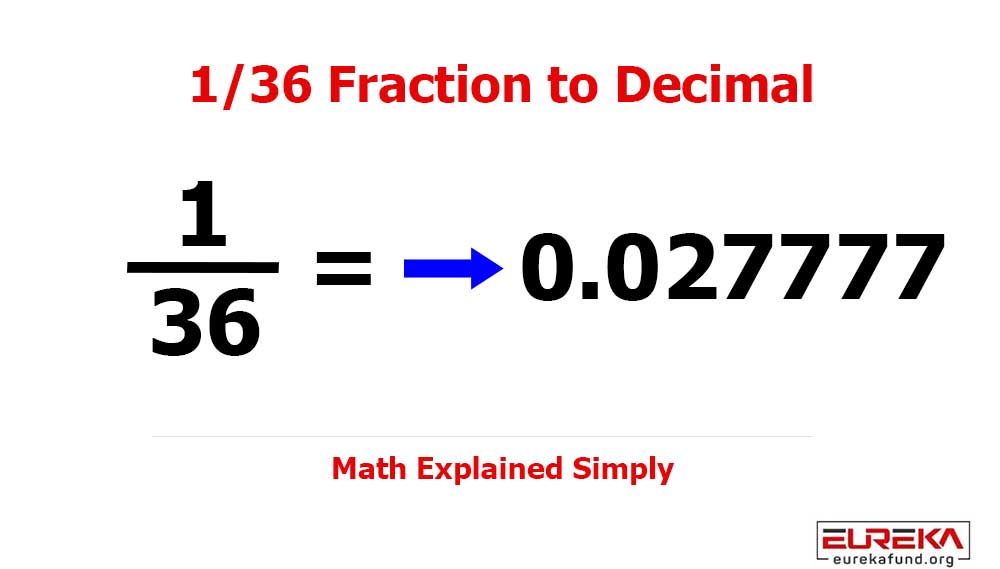
Quick Answer: 1/36 as a decimal is 0.027777…, where the digit 7 repeats infinitely.
It can also be written as 0.02̅7 or 0.027̅.
What Is 1/36 as a Decimal?
When the fraction 1/36 is converted into decimal form, it results in a repeating decimal:
1 ÷ 36 = 0.027777…
This means the digit 7 continues repeating forever after the decimal point. Because the decimal never ends, 1/36 cannot be written as an exact finite decimal.
Step-by-Step: How to Convert 1/36 Into a Decimal
To convert a fraction into a decimal, divide the numerator by the denominator.
Step 1: Write the division
1 ÷ 36
Step 2: Add a decimal point and zeros
Since 36 is larger than 1, we write:
1.0000 ÷ 36
Step 3: Perform long division
- 36 goes into 100 → 2 times (72)
- Remainder: 28
- Bring down 0 → 280 ÷ 36 = 7 (252)
- Remainder: 28 again
At this point, the remainder repeats, so the digit 7 will repeat forever.
Final Result:
1/36 = 0.027777…
See how 0.02777777777 fraction is expressed and simplified.
How to Verify That 1/36 = 0.027777…
You can verify the result using multiple methods:
Method 1: Multiply Back
Multiply the decimal by 36:
0.027777… × 36 = 1
This confirms the decimal value is correct.
Method 2: Fraction Simplification Check
Since 1/36 simplifies to a fraction containing the factor 3, the decimal must repeat.
The repeating pattern matches known fraction behavior.
Method 3: Calculator Confirmation
Dividing 1 by 36 on any calculator will show:
0.027777… (with repeating 7s)
Seeing the same repeating digit confirms the accuracy.
Is 1/36 a Terminating or Repeating Decimal?
1/36 is a repeating decimal.
Why?
A fraction converts into a terminating decimal only if the denominator has prime factors of 2 and/or 5 only.
Let’s factor 36:
36 = 2 × 2 × 3 × 3
Since 3 is included, the decimal must repeat.
Understanding the Repeating Pattern
The repeating part in 0.027777… is the digit 7.
This happens because:
- 36 is divisible by 9
- Fractions related to ninths often produce repeating 7s
For example:
- 1/9 = 0.111…
- 1/18 = 0.0555…
- 1/36 = 0.027777…
Decimal, Fraction, and Percentage Forms
| Form | Value |
| Fraction | 1/36 |
| Decimal | 0.027777… |
| Percentage | 2.7777…% |
To convert to a percentage, multiply the decimal by 100:
0.027777… × 100 = 2.7777…%
Practical Examples of 1/36
- Money: If $1 is divided equally among 36 people, each gets $0.027777…
- Measurements: 1/36 of a unit is slightly more than 0.02 units
- Math & Finance: Used in probability, ratios, and repeating decimal demonstrations
Real-Life Examples and Uses of 1/36
Although 1/36 looks small, it appears in many real-world situations where equal distribution or precise measurement is required.
1. Money Distribution
If 1 dollar is divided equally among 36 people, each person receives $0.027777….
This helps explain why repeating decimals appear in financial calculations when exact division is required.
2. Time Calculations
One hour has 36 equal parts of 100 seconds each in some scientific or technical breakdowns.
Each part represents 1/36 of an hour, which equals 0.027777… hours.
3. Education and Exam Scoring
If a test score is split into 36 equal weight units, each unit contributes 0.027777… toward the final score.
4. Manufacturing and Measurement
In precision manufacturing, dividing a component into 36 identical segments means each segment equals 1/36 of the total length, which in decimal form is 0.027777… of the whole.
5. Probability and Ratios
In probability problems involving 36 equally likely outcomes, each outcome has a probability of 1/36, represented as 0.027777… in decimal form.
Common Mistakes to Avoid
- ❌ Rounding too early (writing 0.028 instead of 0.027777…)
- ❌ Forgetting the repeating nature of the decimal
- ❌ Assuming it terminates because the digits seem short
Always show the repeating digit when accuracy matters.
FAQs About 1/36 as a Decimal
Is 1/36 a repeating decimal?
Yes. 1/36 equals 0.027777…, with the digit 7 repeating infinitely.
Can 1/36 be written as an exact decimal?
No. Because the denominator contains the prime factor 3, the decimal never terminates.
How many decimal places does 1/36 have?
It has infinitely many decimal places due to repetition.
How do you write 1/36 using bar notation?
It can be written as 0.02̅7 or 0.027̅.
Final Answer Summary
- 1/36 as a decimal = 0.027777…
- It is a repeating decimal
- The digit 7 repeats infinitely
- It cannot be written as a terminating decimal
Understanding how and why this repetition occurs helps strengthen fraction-to-decimal conversion skills and prevents rounding errors.