Decimals like 0.21875 appear more often than many people realize—especially in engineering tolerances, digital measurements, finance calculations, and binary-based systems. While decimals are convenient for computation, fractions are often preferred when exact precision matters.
This raises a common question:
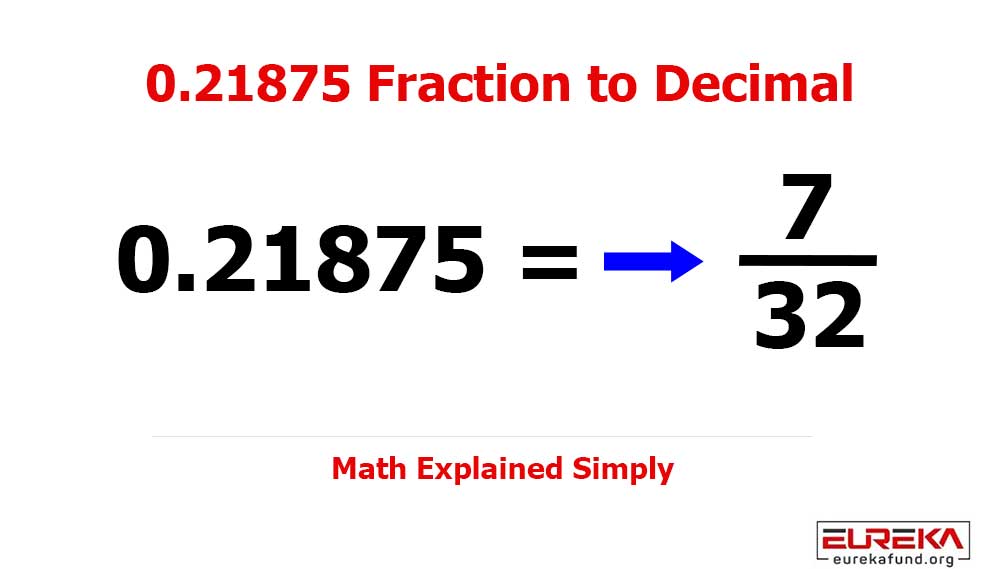
What is 0.21875 as a fraction?
In this guide, we’ll convert the decimal carefully, simplify it fully, verify the result, and explain why this particular decimal converts so cleanly.
Why Convert 0.21875 Into a Fraction?
Converting decimals into fractions is important when:
- Exact values are required (no rounding)
- Working with binary-based measurements
- Using ratios in mathematics or science
- Translating digital values into human-readable form
- Avoiding approximation errors
Decimals like 0.21875 are especially interesting because they come from powers of two, making them highly precise and reliable.
Understanding the Decimal 0.21875
Before converting, it helps to understand the structure of the number.
- 0.21875 is a terminating decimal
- It has five digits after the decimal point
- It can be expressed exactly as a fraction
- It commonly appears in binary and fractional systems
Because it terminates, the conversion will be exact.
Step 1: Write 0.21875 as a Fraction
Since there are five decimal places, place the number over 100,000:
0.21875 = 21875 / 100000
This fraction is mathematically correct, but not yet simplified.
Step 2: Simplify the Fraction
To simplify, we divide both the numerator and denominator by their Greatest Common Divisor (GCD).
Both 21875 and 100000 are divisible by 3125.
Divide both numbers by 3125:
- 21875 ÷ 3125 = 7
- 100000 ÷ 3125 = 32
✅ Final Simplified Fraction
0.21875 as a fraction (simplest form):
7 / 32
You can also see the decimal breakdown here: What is 7/32 as a Decimal?
Step 3: Verify the Result
Decimal Verification
7 ÷ 32 = 0.21875
✔ Exact match
Cross-Multiplication Check
- 21875 × 32 = 700000
- 7 × 100000 = 700000
✔ Both sides are equal, confirming accuracy.
Why Does 0.21875 Simplify So Cleanly?
This decimal is based on binary fractions.
- 1/32 = 0.03125
- 7 × 0.03125 = 0.21875
Because 32 is a power of 2, the decimal terminates cleanly with no repeating digits. This is why values like 0.21875 are common in digital systems, memory allocation, and precision engineering.
Real-World Uses of 0.21875 as a Fraction
🧮 Computing & Digital Systems
- Binary-friendly fractions like 7/32 are used in low-level calculations
- Prevents rounding errors in digital storage
📐 Engineering & Manufacturing
- Fractional tolerances improve measurement reliability
- Preferred over long decimals in calibration
🎼 Music & Timing Ratios
- Fractional divisions of measures and beats
- Ensures exact rhythmic spacing
🎓 Mathematics Education
- Used to teach powers of two
- Common in fraction-decimal conversion lessons
Is 7/32 a Proper Fraction?
Yes.
The numerator (7) is smaller than the denominator (32), so 7/32 is a proper fraction.
Common Mistakes to Avoid
- ❌ Writing 21875 / 10000 instead of 100000
- ❌ Reducing by the wrong common factor
- ❌ Rounding 0.21875 to 0.22 (loses precision)
- ❌ Assuming it is a repeating decimal
Always count decimal places carefully.
Quick Reference Table
| Decimal | Fraction | Simplified |
| 0.21875 | 21875 / 100000 | 7 / 32 |
FAQs: 0.21875 as a Fraction
What is 0.21875 as a fraction in simplest form?
7/32
Is 0.21875 a rational number?
Yes. It can be written as a ratio of two integers.
Is 0.21875 a terminating decimal?
Yes. It ends after five decimal places.
Why does 0.21875 equal 7/32?
Because 0.21875 is exactly seven thirty-seconds.
Is 7/32 commonly used?
Yes, especially in digital, technical, and mathematical contexts.
✅ Final Answer
0.21875 = 7/32
Key Takeaway
To convert 0.21875 into a fraction:
- Write it as 21875 / 100000
- Divide by 3125
- Simplify to 7 / 32
- Verify by division
This conversion is especially valuable in engineering, computing, mathematics, and precision-based fields, where exact values matter more than approximations.
You may also find these related fraction examples helpful: