1/3 as a Decimal
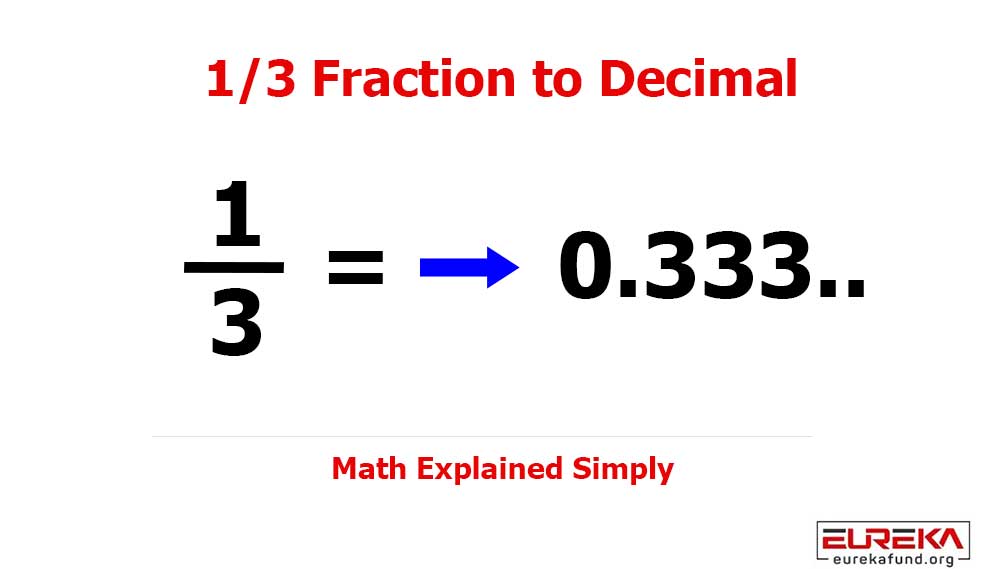
Quick Answer: 1/3 as a decimal is 0.333…, where the digit 3 repeats infinitely.
It is a repeating (non-terminating) decimal.
What Is 1/3 as a Decimal?
To convert the fraction 1/3 into decimal form, divide the numerator by the denominator:
1 ÷ 3 = 0.333…
The decimal does not end. Instead, the digit 3 repeats forever, which is why it is written as 0.3̅ or 0.333….
Step-by-Step: How to Convert 1/3 Into a Decimal
Method: Long Division
1 ÷ 3
- 3 goes into 10 → 3 times (9)
- Remainder = 1
- Bring down another 0 → same remainder appears again
This cycle never ends, so the digit 3 keeps repeating.
Final Result:
1/3 = 0.333…
How to Verify That 1/3 = 0.333…
Method 1: Multiply Back
0.333… × 3 = 1
This confirms the decimal is correct.
Method 2: Fraction Rule Check
Since the denominator contains the prime factor 3, the decimal must repeat.
Method 3: Calculator Observation
Most calculators display 0.333333…, stopping only because of screen limits.
Is 1/3 a Terminating or Repeating Decimal?
1/3 is a repeating decimal.
Why?
A fraction terminates only if the denominator has prime factors 2 and/or 5.
Factorizing 3:
3 = 3
Because 3 is neither 2 nor 5, the decimal cannot terminate.
Understanding the Repeating Pattern
The repeating digit in 0.333… is 3.
This makes 1/3 one of the most common examples used to explain:
- Infinite decimals
- Rational numbers
- Rounding errors in math and computing
Fraction, Decimal, and Percentage Forms
| Form | Value |
| Fraction | 1/3 |
| Decimal | 0.333… |
| Percentage | 33.333…% |
To convert to a percentage:
0.333… × 100 = 33.333…%
Real-Life Examples and Uses of 1/3
In real life, people usually say “one-third” or “about 0.33”, while the exact decimal 0.333… is used in math and calculations.
1. Splitting Items Equally
Dividing something equally among 3 people gives each person 1/3, or 0.333… of the total.
2. Time Division
One-third of an hour equals 20 minutes, even though the decimal form is repeating.
3. Probability
If an event has 1 favorable outcome out of 3, the probability is 1/3 = 0.333….
4. Financial Calculations
In accounting, 1/3 is often rounded to 0.33 or 33%, which can cause small rounding differences.
5. Computing and Programming
Many programming languages cannot store 0.333… exactly, making 1/3 a classic example of floating-point precision limits.
Common Mistakes to Avoid
- ❌ Writing 0.33 as the exact value of 1/3
- ❌ Assuming the decimal eventually ends
- ❌ Forgetting to indicate repetition
- ❌ Treating 0.333… and 0.34 as equal
For accuracy, always show the repeating nature when precision matters.
FAQs About 1/3 as a Decimal
Is 1/3 a terminating decimal?
No. 1/3 is a repeating decimal.
Can 1/3 be written exactly as a decimal?
No. It can only be written as 0.333…, not as a finite decimal.
How do you write 1/3 using bar notation?
It is written as 0.3̅.
What is 1/3 as a percentage?
It equals 33.333…%, with the 3 repeating.
Final Answer Summary
- 1/3 as a decimal = 0.333…
- It is a repeating, non-terminating decimal
- The digit 3 repeats infinitely
- Commonly used to explain repeating decimals and rounding behavior