What Is 1.2 as a Fraction? (Step-by-Step Conversion Explained)
The decimal 1.2 appears often in measurements, pricing, statistics, and math problems. You might see 1.2 kilometers, 1.2 liters, or a value that is 1.2 times larger than another.
While decimals are convenient, fractions often give a clearer mathematical picture, especially in education, ratios, algebra, and real-world applications.
So let’s answer the key question:
What is 1.2 as a fraction?
This guide explains the conversion step by step, simplifies the fraction, verifies the result, and shows where this conversion is useful.
Why Convert 1.2 Into a Fraction?
Converting 1.2 into a fraction is helpful when:
- Solving school or exam math problems
- Working with ratios and proportions
- Comparing values without decimals
- Using fractions in engineering or measurements
- Avoiding rounding errors in calculations
For example, saying something is 6/5 times larger is often clearer than saying 1.2 times larger.
Step 1: Write 1.2 as a Fraction
The decimal 1.2 has one digit after the decimal point, meaning it represents tenths.
So it can be written as:
1.2 = 12 / 10
This fraction correctly represents the decimal value, but it is not yet simplified.
Step 2: Simplify the Fraction
To simplify 12 / 10, we find the greatest common divisor (GCD).
Factors of 12:
1, 2, 3, 4, 6, 12
Factors of 10:
1, 2, 5, 10
The greatest common divisor is 2.
Now divide both numbers by 2:
- 12 ÷ 2 = 6
- 10 ÷ 2 = 5
This gives the simplified fraction:
6 / 5
✅ Final Simplified Fraction
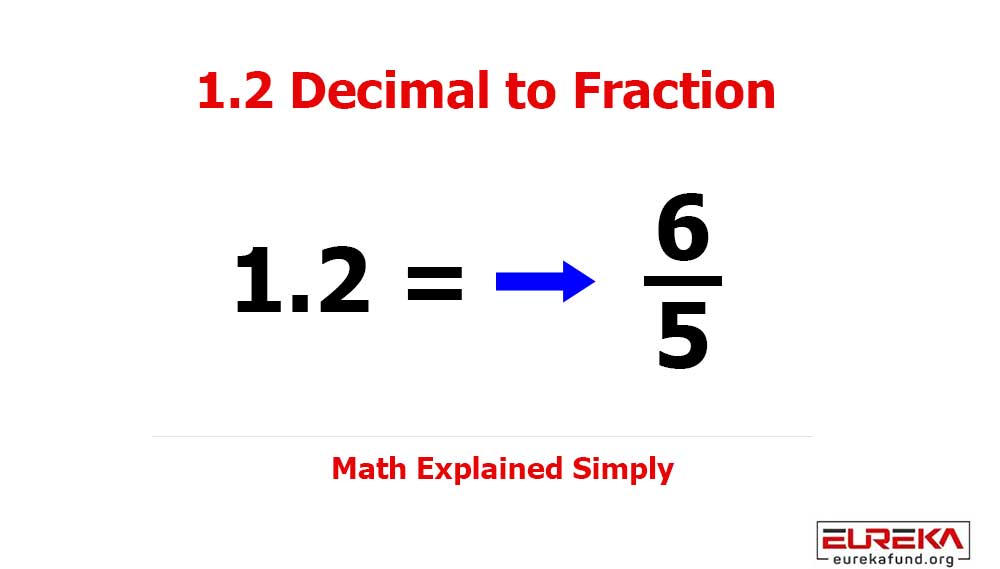
1.2 as a fraction = 6 / 5
You can check the opposite conversion here: 6/5 as a Decimal
Step 3: Verify the Fraction
It’s always good practice to verify your result.
Decimal Verification
Divide the numerator by the denominator:
6 ÷ 5 = 1.2
✔ This confirms the conversion is correct.
Cross-Multiplication Check
- 12 × 5 = 60
- 10 × 6 = 60
✔ Both sides match, confirming accuracy.
Can 1.2 Be Written as a Mixed Number?
Yes.
Since 1.2 is greater than 1, it can also be written as a mixed number.
Convert the improper fraction:
6 / 5 = 1 1 / 5
So:
- 1.2 = 6 / 5
- 1.2 = 1 1 / 5
Both forms are correct.
Real-Life Examples of 1.2 as a Fraction
📏 Measurements
- 1.2 meters = 1 1/5 meters
- Common in construction and science labs
📈 Percentages & Growth
- A 1.2× increase means 6/5 of the original value
- Used in economics, finance, and data analysis
🧪 Science & Engineering
- Ratios like 6/5 are easier to manipulate than decimals
- Helps reduce rounding errors
🎓 Education
- Improper fractions like 6/5 are common in algebra and number theory
Common Mistakes to Avoid
- ❌ Writing 1.2 as 12/100
- ❌ Forgetting to simplify 12/10
- ❌ Confusing 6/5 with 5/6
Always match the number of decimal places before converting.
FAQs: 1.2 as a Fraction
What is 1.2 as a fraction in simplest form?
1.2 = 6 / 5
Is 1.2 an improper fraction?
Yes. 6 / 5 is an improper fraction because the numerator is larger than the denominator.
What is 1.2 as a mixed number?
1 1 / 5
Is 1.2 a terminating decimal?
Yes. It ends after one decimal place and converts cleanly into a fraction.
Why is 1.2 easy to convert into a fraction?
Because it represents 12 tenths, which simplifies neatly to 6/5.
Final Answer
What is 1.2 as a fraction?
1.2 = 6 / 5 or as a mixed number: 1 1 / 5
Key Takeaway
To convert 1.2 into a fraction:
- Write it as 12 / 10
- Simplify using the GCD (2)
- Get 6 / 5
- Convert to a mixed number if needed
This method ensures clarity, accuracy, and consistency in math problems, measurements, and real-world calculations.
You may also find these fraction guides useful: