What is 0.875 as a Fraction? (Step-by-Step Conversion Guide)
Decimals are a common way to express numbers, especially in measurements, prices, and calculations. However, in many real-life situations — such as woodworking, baking, sewing, and engineering — fractions are easier to visualize and apply.
If you’re wondering:
What is 0.875 as a fraction?
This guide walks you through the conversion step by step, simplifies the fraction correctly, verifies the result, and shows where this conversion is commonly used.
Why Convert 0.875 into a Fraction?
Although decimals and fractions represent the same value, fractions are often preferred because they:
- Provide clearer and more practical measurements
- Reduce rounding errors
- Are standard in technical and hands-on fields
For example, a carpenter is far more likely to work with 7/8 of an inch than 0.875 inches. The fraction form is quicker to read and easier to measure on tools.
Step 1: Write 0.875 as a Fraction
The decimal 0.875 has three digits after the decimal point, which means it represents thousandths.
So we write it as:
0.875 = 875 / 1000
This fraction correctly represents the decimal value, but it is not yet in simplest form.
Step 2: Simplify the Fraction
To reduce the fraction, we divide both the numerator and denominator by their greatest common divisor (GCD).
Factors of 875:
1, 5, 7, 25, 35, 125, 175, 875
Factors of 1000:
1, 2, 4, 5, 8, 10, 20, 25, 40, 50, 125, 200, 250, 500, 1000
The greatest common divisor is 125.
Now divide both numbers by 125:
- 875 ÷ 125 = 7
- 1000 ÷ 125 = 8
This gives the simplified fraction:
7 / 8
✅ Final Simplified Answer
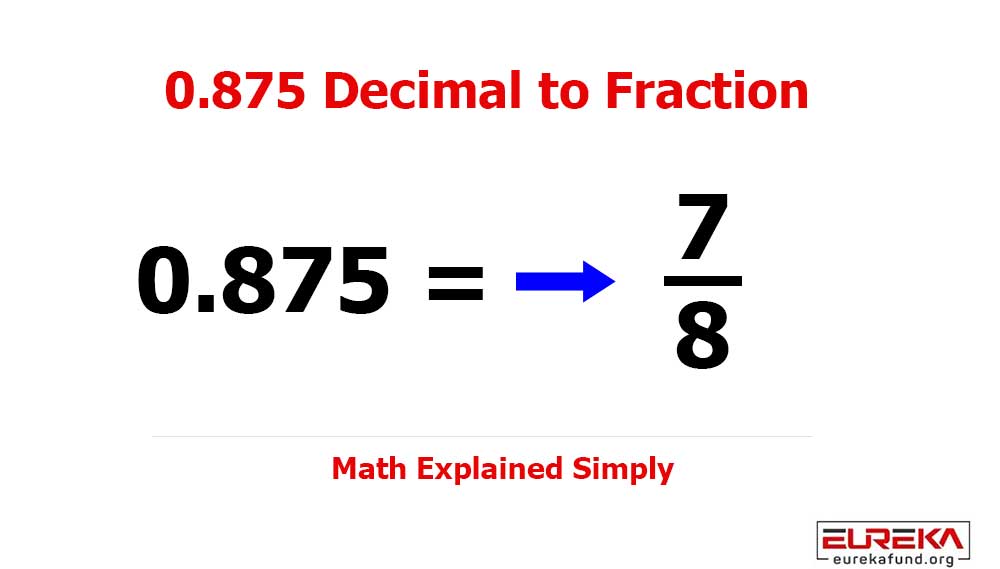
0.875 as a fraction = 7 / 8
You can also see the decimal form here: 7/8 as a Decimal
Step 3: Verify the Result
Verification ensures accuracy and builds confidence.
Decimal Verification
Divide the numerator by the denominator:
7 ÷ 8 = 0.875
✔ This confirms the conversion is correct.
Cross-Multiplication Check
- 875 × 8 = 7000
- 7 × 1000 = 7000
✔ Both sides match, confirming accuracy.
Is 7/8 the Simplest Form?
Yes.
The fraction 7 / 8 is already in its simplest form because 7 and 8 share no common factors other than 1.
Where Is 0.875 Commonly Used?
🛠 Construction & Measurements
- 7/8 inch is a standard measurement in tools, lumber, and drilling
- Much more practical than measuring 0.875 inches on a ruler
🧵 Sewing & Fabric Cutting
- Fabric patterns often use fractions like 7/8 yard
- Fractions reduce mistakes when measuring manually
📘 Mathematics & Education
- Appears frequently in fraction–decimal conversion exercises
- Useful for learning fraction simplification
🧪 Science & Engineering
- Fractions provide exact values where decimals may be rounded
- Helpful in tolerance-based and precision calculations
Common Mistakes to Avoid
- ❌ Writing 875 / 100 instead of 875 / 1000
- ❌ Forgetting to simplify the fraction
- ❌ Assuming 0.875 equals 3/4 (it does not)
Taking time to simplify ensures accuracy and clarity.
FAQs: 0.875 as a Fraction
Is 0.875 equal to 7/8?
Yes. 0.875 converts exactly to 7 / 8.
Can 0.875 be written as a mixed number?
No. Since it is less than 1, it remains a proper fraction.
Why does 0.875 simplify so cleanly?
Because 875 and 1000 share a large common factor (125).
Is 14/16 the same as 0.875?
Yes mathematically, but 7/8 is the simplest and preferred form.
How is 0.875 different from 0.625?
- 0.875 = 7 / 8
- 0.625 = 5 / 8
They share the same denominator but represent different values.
✅ Final Answer
What is 0.875 as a fraction?
0.875 = 7 / 8
Key Takeaway
To convert 0.875 into a fraction:
- Write it as 875 / 1000
- Find the GCD (125)
- Simplify to 7 / 8
- Verify the result
This conversion is especially useful in construction, sewing, education, and precise measurements, where fractions are clearer and more practical than decimals.
You may also find these related fraction examples helpful: