0.16667 as a Fraction (Exact Value vs Rounded Meaning Explained)
The decimal 0.16667 is commonly seen in calculators, spreadsheets, probability results, and percentage-based calculations. At first glance, it appears to be a terminating decimal, but in most real-world contexts, 0.16667 is actually a rounded approximation of a repeating decimal.
This leads to an important question:
What is 0.16667 as a fraction — and is it exact or approximate?
In this article, you’ll learn how to convert 0.16667 into a fraction, understand its true mathematical meaning, verify the result, and see where this conversion is commonly used.
Why Convert 0.16667 into a Fraction?
Converting decimals like 0.16667 into fractions helps when:
- Interpreting calculator or spreadsheet outputs
- Working with ratios, probabilities, and statistics
- Avoiding confusion between exact and rounded values
- Preparing for math exams or technical calculations
- Understanding repeating decimal patterns
Fractions clearly show whether a number is precise or approximate, which is essential in mathematics and data analysis.
Understanding the Decimal 0.16667
Before converting, it’s important to understand what this decimal represents.
- 0.16667 is a rounded decimal
- It approximates the repeating decimal 0.16666…
- The repeating decimal 0.16666… equals exactly 1/6
Because calculators often round results to five decimal places, 0.16667 is commonly used to represent 1/6.
Method 1: Exact Decimal-to-Fraction Conversion
Step 1: Write 0.16667 as a Fraction
Since there are five digits after the decimal, place the number over 100,000:
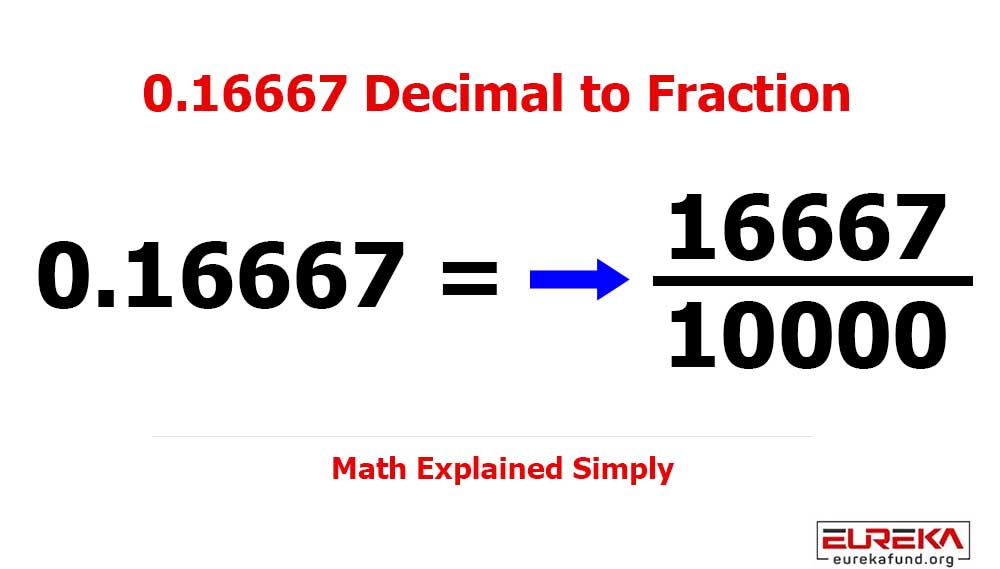
0.16667 = 16667 / 100000
Step 2: Simplify the Fraction
- 16667 has no common factors with 100000
- The fraction cannot be reduced further
✅ Exact Fraction Result
0.16667 = 16667 / 100000
This fraction is exact, but it represents a rounded value, not a repeating one.
Method 2: Fraction Based on Mathematical Intent (Most Common Use)
In most mathematical, educational, and statistical contexts, 0.16667 is intended to represent the fraction 1/6.
Why?
- 1 ÷ 6 = 0.166666… (repeating)
- Rounded to five decimal places → 0.16667
So practically:
0.16667 ≈ 1 / 6
✅ Most Commonly Accepted Fraction
0.16667 ≈ 1/6
✔ This is the fraction people almost always mean when writing 0.16667.
Verification
Decimal Check
- 1 ÷ 6 = 0.166666…
- Rounded → 0.16667
✔ The values align.
Exact vs Approximate Comparison
| Decimal | Fraction | Meaning |
| 0.16667 | 16667/100000 | Exact rounded value |
| 0.1666… | 1/6 | Exact repeating value |
⚠️ 0.16667 is not exactly equal to 1/6, but it is an extremely close approximation.
Real-Life Uses of 0.16667
📊 Statistics & Data
- Ratios rounded for reports and dashboards
- Probabilities shown with fixed decimal precision
💰 Finance
- Percentage-based calculations
- Dividing values into six equal parts
🎓 Education
- Fraction–decimal conversion exercises
- Exam answers expected as 1/6
🧮 Probability
- One out of six chance
- Easier to interpret as 1/6 than a long decimal
Common Mistakes to Avoid
- ❌ Treating 0.16667 as an exact value of 1/6
- ❌ Writing 16667/1000 (wrong place value)
- ❌ Forgetting rounding context
- ❌ Assuming all decimals terminate
Understanding rounding prevents conceptual errors.
FAQs: 0.16667 as a Fraction
What is 0.16667 as a fraction?
- Exact: 16667/100000
- Common meaning: 1/6
Is 0.16667 equal to 1/6?
Not exactly — it is a rounded approximation.
Why do calculators show 0.16667 instead of repeating 6s?
Because calculators round repeating decimals to a fixed number of digits.
Is 0.16667 a rational number?
Yes. All terminating decimals are rational numbers.
Which fraction should I use in exams?
Use 1/6, unless the question specifically asks for a rounded decimal fraction.
✅ Final Answer Box
0.16667 as a Fraction
- Exact: 16667 / 100000
- Commonly Intended: 1 / 6
Key Takeaway
To convert 0.16667 into a fraction:
- Write it as 16667/100000 for exact precision
- Recognize it usually represents 1/6
- Understand the difference between rounded and repeating decimals
- Use 1/6 when an exact fractional value is expected
This clarity is essential for math, statistics, finance, and education.
You may also find these related fraction examples helpful: