0.02777777777 as a Fraction (Repeating Decimal Explained Clearly)
The decimal 0.02777777777 may look complicated at first, but it follows a very recognizable mathematical pattern. You’ll often see numbers like this in calculators, probability results, and percentage-based calculations where repeating decimals are rounded.
So the key question is:
What is 0.02777777777 as a fraction, and what does it really represent?
In this article, you’ll learn:
- Whether 0.02777777777 is exact or rounded
- How to convert it into a fraction step by step
- The simplest and most meaningful fractional form
- How to verify the result
- Where this conversion is commonly used
Why Convert 0.02777777777 into a Fraction?
Converting repeating decimals into fractions helps when:
- Understanding calculator outputs
- Working with ratios and probabilities
- Avoiding rounding confusion
- Solving algebra and exam problems
- Expressing values in exact form
Fractions clearly show precision, while decimals often hide repetition through rounding.
Understanding the Decimal 0.02777777777
Before converting, it’s important to recognize the pattern.
- The digit 7 repeats continuously
- 0.02777777777 is a rounded form of
0.0277777777… - This is a repeating decimal
In mathematics, repeating decimals always correspond to exact fractions.
Step 1: Identify the Repeating Pattern
The repeating part is:
0.0277777777…
This can be rewritten as:
0.02 + 0.0077777777…
Step 2: Convert the Repeating Portion
A key fact in math:
- 0.777777… = 7/9
- Therefore, 0.07777777… = 7/90
- And 0.007777777… = 7/900
Now add the non-repeating part:
- 0.02 = 2/100 = 1/50
Step 3: Add Both Parts
So we have:
- 1/50 + 7/900
Find a common denominator (900):
- 1/50 = 18/900
- 7/900 = 7/900
Add them:
- 18/900 + 7/900 = 25/900
Step 4: Simplify the Fraction
25 and 900 share a common factor of 25.
Divide both by 25:
- 25 ÷ 25 = 1
- 900 ÷ 25 = 36
✅ Final Simplified Fraction
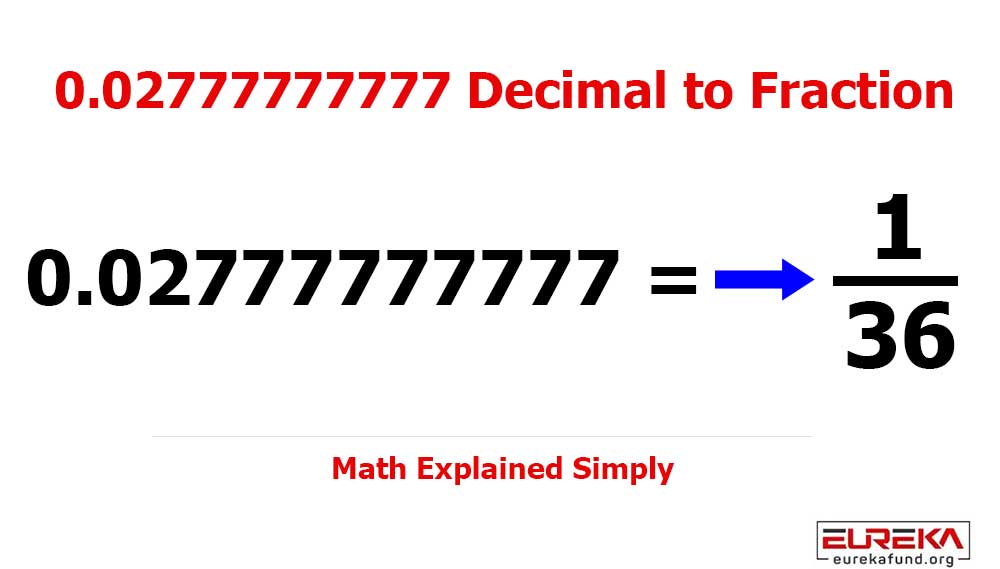
0.02777777777 = 1 / 36
Learn how 1/36 as a decimal is calculated step by step.
Step 5: Verify the Result
Decimal Check
- 1 ÷ 36 = 0.0277777777…
✔ Matches the original repeating decimal.
Is 0.02777777777 an Exact Decimal?
❌ No.
It is a rounded representation of a repeating decimal.
✔ The exact fractional value is 1/36.
Real-Life Examples of 0.02777777777
📊 Probability
- A probability of 1 out of 36
- Common in dice combinations and statistics
🎓 Education
- Used in lessons on repeating decimals
- Helps students recognize fraction patterns
🧮 Mathematics
- Appears in fraction-to-decimal conversions
- Useful in algebra and number theory
📈 Data & Calculations
- Rounded decimal outputs in calculators
- Stored as repeating values internally
Common Mistakes to Avoid
- ❌ Treating 0.02777777777 as a terminating decimal
- ❌ Writing it as 2777777777/100000000000 (unnecessary)
- ❌ Ignoring the repeating pattern
- ❌ Leaving the value unsimplified
Recognizing repetition is the key step.
FAQs: 0.02777777777 as a Fraction
What is 0.02777777777 as a fraction?
1/36
Is 0.02777777777 equal to 1/36 exactly?
Yes. The decimal is a rounded display of the repeating value.
Is 0.02777777777 a rational number?
Yes. All repeating decimals are rational.
Why do calculators stop at several 7s?
Because they round repeating decimals to a fixed precision.
Should I use 1/36 in exams?
Yes. Fractions are preferred for exact answers.
✅ Final Answer Box
0.02777777777 as a Fraction (Simplest Form)
1 / 36
Key Takeaway
To convert 0.02777777777 into a fraction:
- Recognize the repeating 7 pattern
- Convert the repeating decimal mathematically
- Simplify the result
- Arrive at 1/36
This method is essential for handling repeating decimals accurately in math, probability, and real-world calculations.
You may also find these related fraction examples helpful: